
Why Weather Forecasts Are Sometimes Wrong: Understanding Forecast Uncertainty
Sources reviewed: 2026-07-16
Definitions, thresholds, and safety guidance are checked against the primary sources listed below.
If you've ever packed for sunshine and been caught in a downpour, you know the frustration of a forecast that "got it wrong." But modern forecasts are actually remarkably good — a five-day forecast today is as accurate as a one-day forecast was in the 1980s. Understanding why forecasts still miss helps you use them far more wisely.
The Chaos Factor
Weather is a chaotic system — extraordinarily sensitive to its starting conditions. A tiny error in temperature, pressure or humidity in one place can snowball into a big difference somewhere else days later. This is the famous butterfly effect: the idea that a butterfly flapping its wings in Brazil could, in theory, tip the scales toward a tornado in Texas.
The takeaway: even with perfect instruments and infinite computing power, weather prediction has inherent limits. Beyond about two weeks, day-to-day forecasting becomes essentially impossible.
How Modern Forecasting Works
- Data collection: weather stations, satellites, radar and balloons gather millions of observations every day.
- Numerical Weather Prediction (NWP): supercomputers solve equations of physics to simulate how the atmosphere will evolve.
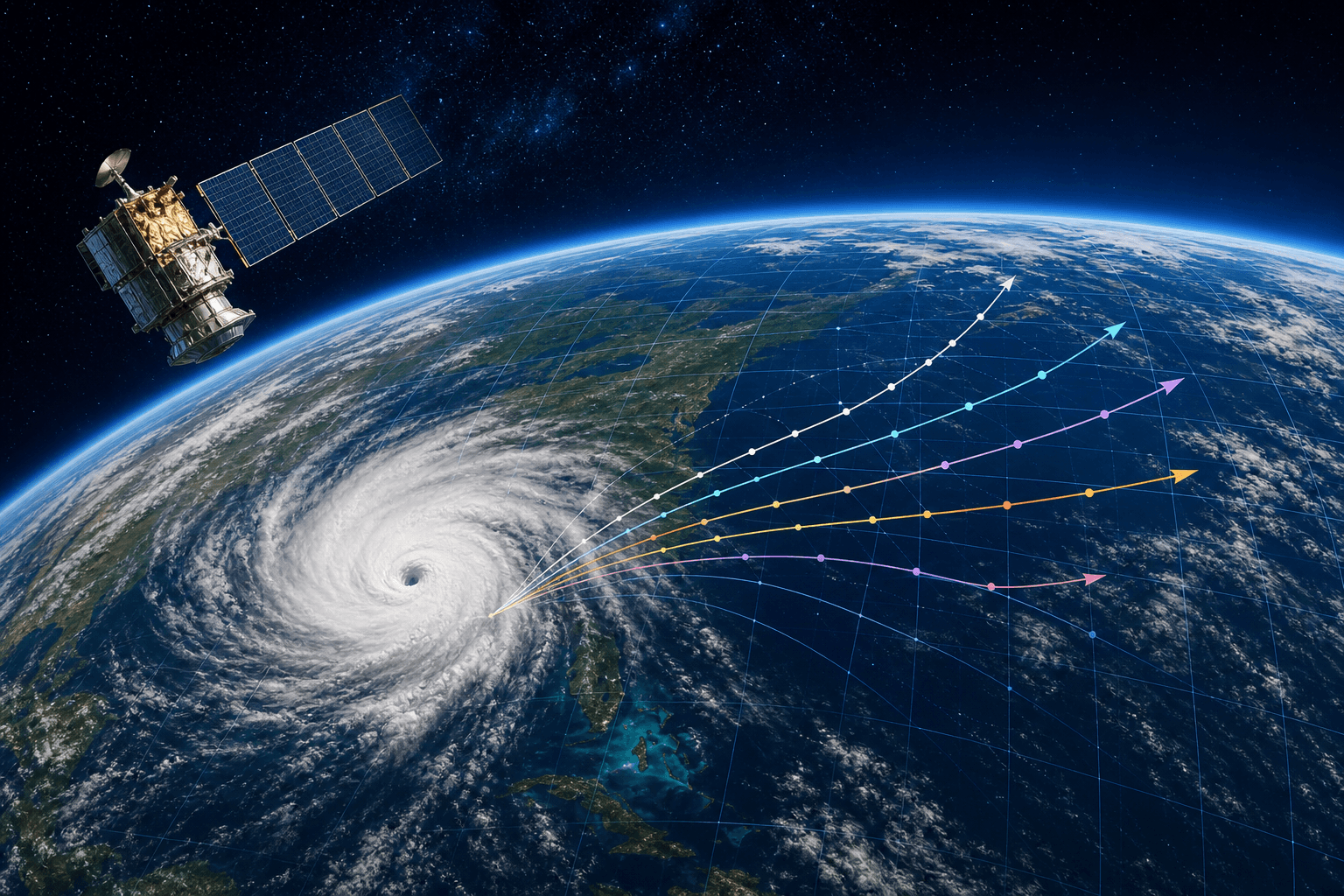
- Ensemble forecasting: models are run dozens of times with slightly different starting points; if the runs agree, confidence is high — if they diverge, uncertainty is high.
- Human analysis: meteorologists interpret the models and correct for local effects the computers miss.
Why Accuracy Drops Over Time
Because small errors grow, forecast skill fades the further out you look:
| Lead time | Roughly how reliable |
|---|---|
| Today / tomorrow | ~80–90% for high/low temperature |
| 3-day | Still quite reliable (~75–80%) |
| 5-day | Generally useful (~70%) |
| 7-day | Good for trends, not specifics |
| Beyond 10 days | Patterns only, not daily detail |
The Hardest Things to Forecast
- Thunderstorms: small and fast-forming, so exact timing and location are tough.
- Snow vs. rain: a difference of a single degree flips the precipitation type — and the snow total.
- Fog: depends on very local temperature, moisture and wind.
- Hurricane tracks: tiny changes in steering winds shift the path by hundreds of kilometers.
- Exactly where heavy rain sets up: a storm can dump on one town and skip the next.
How to Use Forecasts More Wisely
- Re-check as the day approaches: confidence usually jumps in the final 24–48 hours.
- Read the probability: "40% chance of rain" is information, not a mistake — plan for the odds.
- Watch for updates on high-impact events rather than trusting a single 10-day snapshot.
- Treat long-range forecasts as trends, not promises about a specific day.
Key idea
A forecast isn't a promise — it's the most likely outcome given imperfect information about a chaotic system. The nearer the event, the sharper it gets.
Sources: National Weather Service, American Meteorological Society, ECMWF.
Sources and further reading
These primary sources were used to check definitions, thresholds, safety guidance, and scientific context.
Sources reviewed: 2026-07-16
- NOAA NESDIS: How Reliable Are Weather Forecasts?
Why forecast reliability generally decreases with longer lead time.
- NOAA NESDIS: Weather Forecasting Educational Resources
Observations, models, and forecaster judgment in the forecasting process.
What AnyWeather adds
We explain forecast uncertainty through lead time, model limits, observations, and local microclimates instead of treating one forecast as a promise.
This article is an independent synthesis of public sources; the listed institutions do not endorse AnyWeather. For weather or health risks, prioritize local official alerts and professional advice.
Frequently Asked Questions
Why are weather forecasts sometimes wrong?
Weather is a chaotic system, so tiny errors in the starting data grow over time (the butterfly effect). Even with excellent instruments and supercomputers, this puts a hard limit on how far ahead we can predict specific weather, so forecasts are probabilities, not guarantees.
How accurate are weather forecasts?
Same-day and next-day temperature forecasts are typically 80–90% accurate, a 3-day forecast around 75–80%, and a 5-day forecast about 70%. Beyond 7 days, forecasts show general trends rather than reliable daily detail.
What does '40% chance of rain' actually mean?
It's the probability of measurable precipitation at a given point during that period. A 40% chance means rain is more likely not to occur than to occur, but it's far from negligible — it's useful information for planning, not a forecasting error.
Which weather is the hardest to predict?
Small-scale, fast-forming events are the toughest: thunderstorms, fog, the exact rain/snow line, precisely where heavy rain will fall, and the exact track of hurricanes, where small changes in steering winds shift the path dramatically.
Related Articles
Understanding Air Quality Index (AQI): Everything You Need to Know
What is AQI? How is it calculated? What do the different levels mean? This article explains the Air Quality Index to help you protect your respiratory health.
ReadHeat Index vs Feels Like: What's the Difference Between Actual and Feels Like Temperature?
Why does 20C sometimes feel like 10C? It's all about the 'Feels Like' temperature. Learn about wind chill and heat index to dress smarter.
ReadEl Niño vs La Niña: How Ocean Cycles Direct Global Weather
From grocery prices to hurricanes, from mild winters to droughts, El Niño and La Niña quietly steer weather worldwide. Here's what they are, why they happen, how long they last, and how scientists track them.
Read